
**Unveiling the AD574AUD: A Comprehensive Guide to the 12-Bit Analog-to-Digital Converter**
In the realm of data acquisition and digital signal processing, the conversion of real-world analog signals into precise digital values is a fundamental task. At the heart of many sophisticated systems lies a critical component: the Analog-to-Digital Converter (ADC). Among the plethora of options available, the **AD574AUD stands out as a quintessential and historically significant 12-bit ADC**, renowned for its balance of performance, reliability, and ease of use. This guide delves into the architecture, functionality, and application of this iconic integrated circuit.
The AD574AUD is a complete, **monolithic 12-bit successive approximation ADC** that integrates all the necessary components—including a voltage reference, clock, and digital interface circuitry—on a single chip. This high level of integration was a remarkable feat at its introduction, simplifying design and reducing the board space required for high-accuracy conversion. It is designed to **offer both accuracy and speed**, typically achieving conversion times in the range of 25 to 35 microseconds, making it suitable for a wide array of medium-speed applications.
A key feature of the AD574AUD is its versatile input configuration. It can accept analog input signals in multiple ranges, including **bipolar (±5V, ±10V) and unipolar (0 to +10V, 0 to +20V) modes**, selected through simple pin strapping. This flexibility allows designers to interface directly with a variety of sensors and signal conditioning circuits without the need for additional external components. The built-in +10.0V precision voltage reference ensures stable and accurate conversions, which is paramount for maintaining overall system integrity.
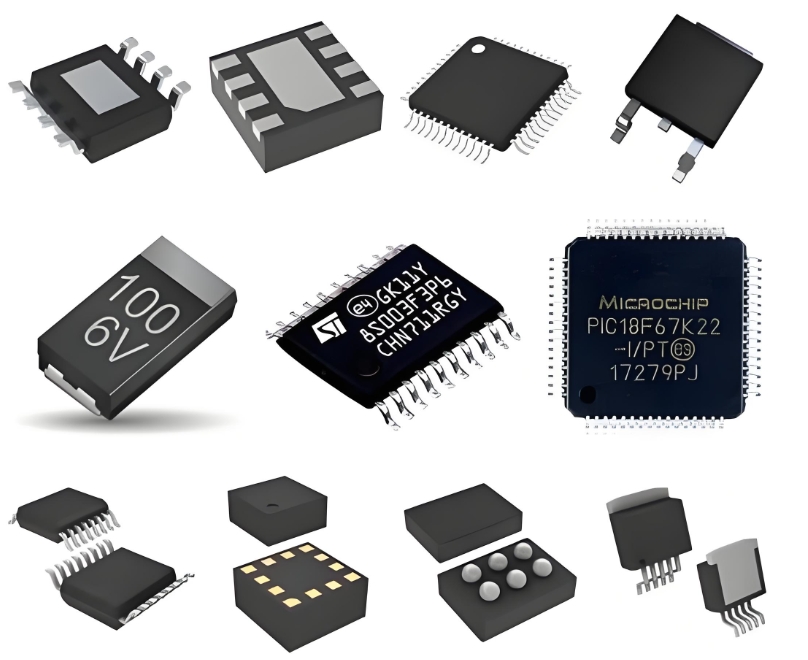
The digital interface of the AD574AUD is designed for straightforward connection to microprocessors and microcontrollers. It features **three-state output buffers** that allow it to be directly tied to a data bus, facilitating easy reading of the conversion result. The control logic accepts signals for initiating conversion and reading data, making the handshake process with a controlling CPU simple and efficient. Its 12-bit output can be read in one 12-bit operation or as two 8-bit bytes (an 8-bit upper byte and a 4-bit lower byte), providing compatibility with both 8-bit and 16-bit systems.
Typical applications for the AD574AUD are extensive. It has been a workhorse in **industrial control systems, precision instrumentation, and data acquisition systems (DAQs)**. From measuring temperature and pressure to analyzing audio signals, its 12-bit resolution provides a quantum size of 1 part in 4096, delivering the granularity needed for many high-precision tasks.
Despite being a classic component, the principles and performance benchmarks set by the AD574AUD continue to be relevant. It serves as an excellent educational tool for understanding ADC operation and remains a viable solution for projects requiring robust and dependable performance without the extreme speed of modern ADCs.
**ICGOODFIND**: The AD574AUD is more than just a converter; it is a landmark in analog-to-digital conversion technology. Its **all-in-one design, flexible input ranges, and microprocessor-compatible interface** solidified its status as a go-to solution for engineers for decades, embodying a perfect blend of performance and practicality that is still admired today.
**Keywords**: Analog-to-Digital Converter, 12-Bit Resolution, Successive Approximation, Microprocessor Interface, Data Acquisition.

